
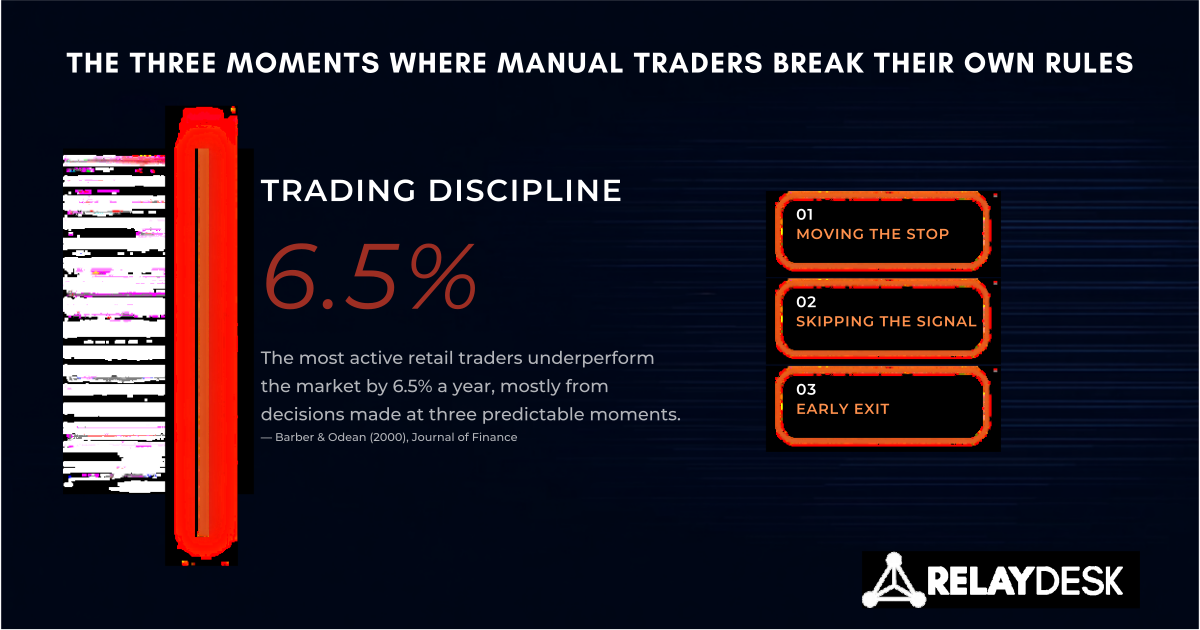
Every trader has a plan. It rarely fails on paper. It fails at three specific moments, and they are the same three for almost every discretionary trader.
The cost of manual trading
Find your leakEvery trader has a written plan. Stop loss at X, target at Y, position size capped at Z percent of the account. The plan rarely fails on paper.
It fails at three specific moments, and they are the same three moments for almost every discretionary trader. Automated execution does not make you a better strategist. It removes the option to break your own rules at exactly those moments.
Moment one: moving the stop once the trade is underwater
A trade goes against you. The stop is five minutes away from triggering. You tell yourself the level is about to hold, the volume looks exhausted, the setup is still valid.
You move the stop. Sometimes it works out. The times it does not are the ones that erase months of gains in a single session.
A bot does not have a version of this moment. The stop order sits at the broker with the level you set when you placed the trade, not the level you wish you had set five minutes ago.
Moment two: hesitating after two losses in a row
Your system says enter. You look at the last two trades, both losers, and you skip the third signal. It feels like risk management. It is actually a change to your system's win rate, made in real time, based on a sample size of two.
Systems with a real edge lose in streaks. Skipping signals after a losing streak means you are systematically absent for the trade that follows it, which is often the one that recovers the drawdown. Removing that decision point is not about ignoring risk. It is about not making a new risk decision every time the last one did not go your way.
Moment three: closing a winner early
A position is up. You take the profit before your target because you do not want to watch it round-trip back to breakeven. The trade might have run further. You will never know, because you closed it on a feeling rather than a level.
This one is the hardest to fix manually because it feels like prudence, not error. But if your backtest assumed you would hold to target and you consistently exit early, your live results will underperform your backtest by a predictable, measurable amount.
Why the bot doesn’t break here
None of this is about bots having better judgment than you. A bot has no judgment. It has the order you gave it, and it submits that order when the condition you defined is met.
The value is not intelligence. The value is that the rule executes identically every time, regardless of how the last trade felt or how the current one is going.
What has to be true before automation helps
Automating a bad rule does not make it a good rule. If your stop placement is wrong, your bot will lose money exactly as fast as you would, just without the emotional detour.
Automation only pays off once you have a rule set you trust enough to run unmodified. That means backtesting it, understanding its drawdown profile, and accepting the losing streaks it will produce before you ever connect it to a live account.
Seeing the gap in your own trading
If you’ve been trading manually, you likely already know which of these three moments costs you the most. RelayDesk's Signal History log gives you a way to check instead of guessing: every signal that fired, whether it executed as written, and the price and timing of the fill.
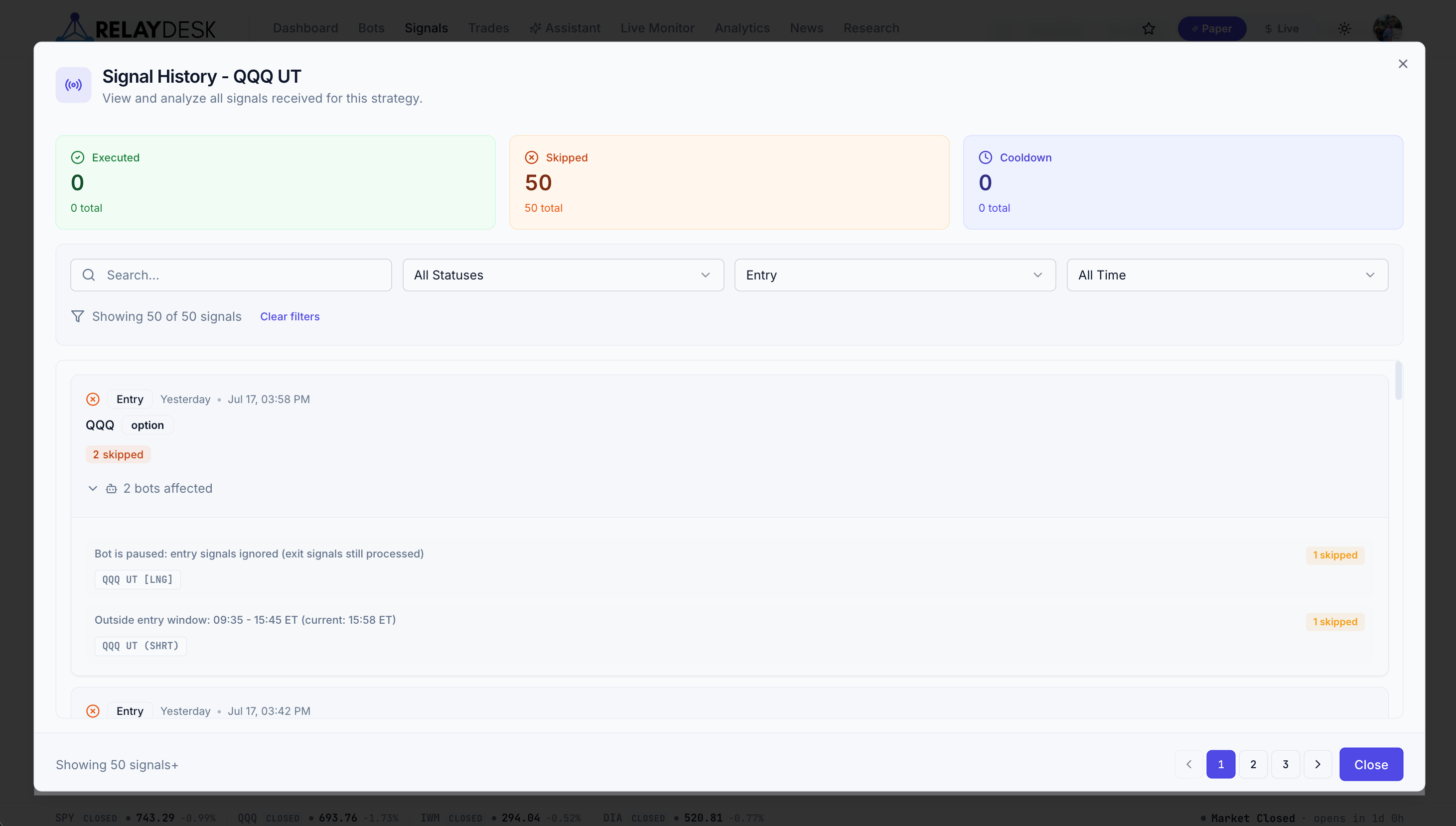
Comparing that log against your own trade history for the same period shows you exactly where manual decisions diverged from the plan, and what that divergence cost.
What the published research actually says these moments cost
The three moments above are directional. The research behind them is not.
Crossing a wide bid-ask spread in a hurry costs retail options traders 5 to 10 percent or more per trade, according to Bogousslavsky and Muravyev's analysis of retail option trading. Trading earnings on emotion carries its own tax: de Silva, Smith, and So found retail traders lose 5 to 9 percent on options positions around earnings announcements, rising to 10 to 14 percent in high-volatility setups, with roughly $3 billion in aggregate retail losses transferred to market makers over their sample window.
The pattern holds at the account level, not just the trade level. Barber and Odean's research on retail trading found the most active traders underperform the market by roughly 6.5 percent a year, largely from the accumulated cost of decisions like the three moments above. On 0DTE contracts specifically, Beckmeyer, Branger, and Gayda found retail debit trades lose an average of 8 dollars per contract while credit trades gain 4.55, a structural transfer from buyers to sellers that runs independently of any single trader's skill.
None of these numbers describe a rare mistake. They describe a routine one, repeated often enough to show up in decades of market microstructure data.
Putting a number on your own version of this
The research above describes averages across large samples of retail traders. Your own numbers depend on how often you trade, how you size positions, and which of these moments you hit most.
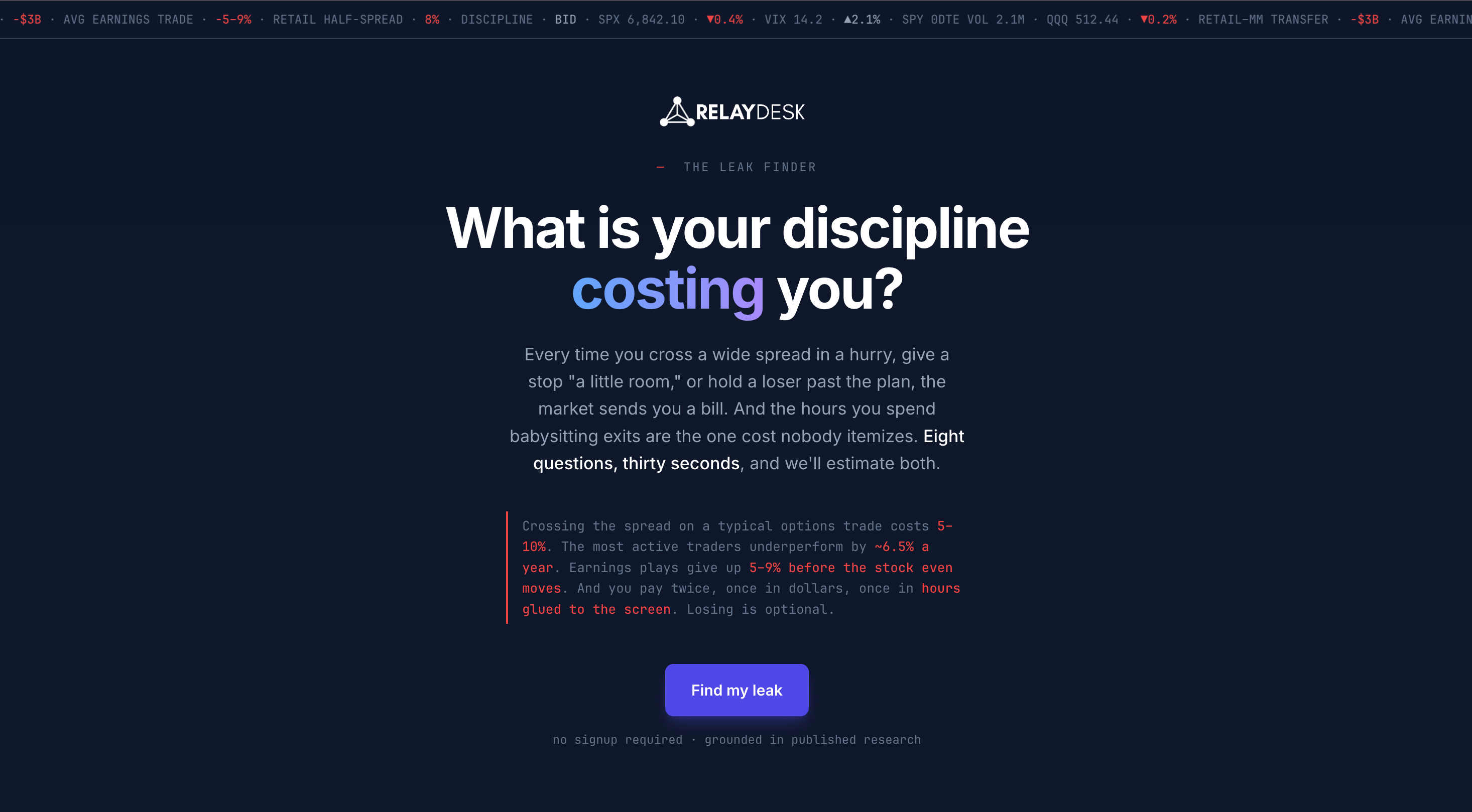
RelayDesk built the Leak Finder to answer that specific question. It applies the published loss rates above to your self-reported trading frequency, position size, and habits, then itemizes an estimated annual cost, broken down by exactly the behaviors covered in this article: moved stops, held losers, earnings IV crush, and spread bleed. It takes about thirty seconds and requires no signup to see the estimate.
Moving from manual override to rules-based execution
Start with the rule you break most often, not your whole strategy at once. If it is the stop-widening habit, automate stop placement first and keep discretion over entries while you build confidence in the system holding the line.
Expand from there. The goal is not to remove yourself from trading. It is to remove the specific moments where you already know, after the fact, that you made the wrong call.
Sources
Bogousslavsky, V. and Muravyev, D. (2024). An Anatomy of Retail Option Trading. SSRN Working Paper.
de Silva, T., Smith, K. and So, E.C. (2022). Losing is Optional: Retail Option Trading and Expected Announcement Volatility. SSRN Working Paper.
Barber, B.M. and Odean, T. (2000). Trading Is Hazardous to Your Wealth: The Common Stock Investment Performance of Individual Investors. The Journal of Finance, 55(2), 773-806.
Beckmeyer, H., Branger, N. and Gayda, L. (2023). Retail Traders Love 0DTE Options... But Should They? SSRN Working Paper.
RelayDesk is a trading automation platform. We are not a broker-dealer or investment advisor and do not provide investment advice. Trading involves substantial risk of loss. Past performance is not indicative of future results. View full disclaimer